

 Log in / Register
Many a car company boasts its own museum – warehouses stacked with best of breed machines from its back catalogue – rotter’s conspicuous in their absence. These collections usually reside in an industrial estate somewhere, tucked away far enough for only the most resolute of enthusiasts to discover. In many ways the Museo Storico Alfa Romeo is little different. After all, it’s housed on a nondescript back road in Arese, a Milanese suburb, and its exhibits are indeed conspicuous – if only for their lack of rust. There is, however, one way in which this museo storico does differ from other companies’ efforts. It hardly needs spelling out. This is an Alfa Romeo museum.

Even the building looks better. Although a warehouse like any other, Alfa has somehow styled it, building an enormous tunnelled entrance with grand swoops and glorious curves. It’s painted rosso, like many of the classics naturally. The tunnel came in useful on the day of my visit, given the biblical levels of rain outside. It could have been more useful still, had it not been for the puddles collecting in the countless dips and bumps along the walkway. For all its grand swoops and glorious rosso curves the tarmac entrance wasn’t even nearly level. How Alfa Romeo is that?
Upon entering you are greeted by a shiny new Giulia and Stelvio, resplendent in Alfa’s Formula One livery, an expensive gift shop selling items you don’t need but definitely want (Alfa Romeo stationary anyone?), and a handful of attractive, smartly dressed employees milling about. Everything just as you’d expect. Entry costs €12.
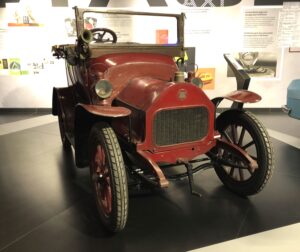
Vintage Alfa Romeo on display at Alfa Romeo Museum Aresi Italy
Turn the corner and you are presented with the museum’s opening gambit – a selection of the most left-field and eclectic Alfas in existence. These oddballs include an Alfa 6 Pope-mobile, the ‘Pidocchio’ Tipo 103 Prototype, 1906 Darracq 8/10hp (the company A.L.F.A originated from) and a battle-worn 1959 Giulia prototype. Of more interest was the Giugiaro-penned Alfa New York Taxi from 1976. With its Blade Runner-esque lines, it is a fascinating glimpse at what American life would be like if the Italians got hold of the drawing board. There’s something about the combination of elegance and utilitarianism that the Italians get so right, and none more so than the superb Matta and the achingly cool 164 fire engine – specially designed for servicing Alfa’s Balocco test track – sitting near the museum entrance.
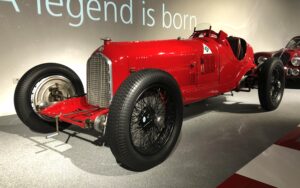
Beautiful racing Alfa Romeo on display at Alfa Museum in Aresi Italy
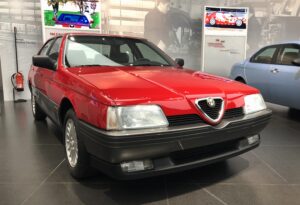
Next stop is a collection of Alfa’s vintage aeroplane engines – a wholly unexpected but imposing spectacle – and some intriguing graphics depicting the company’s badge changes through the years. After this you are presented with an enormous set of escalators rising through a red tunnel, presumably designed to mimic an artery leading to Alfa’s ‘heart’. This is when the museum really begins to reveal its treasures. The escalator leads to an open-planned area filled with vintage Alfas. Thanks to the swathes of glass used throughout the museum, you are teased with sights from the lower levels – a 158 Alfetta here, an 8C Competizione there. You cannot fail to be excited. First up is a 1911 A.L.F.A 15hp Corsa, giving a glimpse of what life might have been like as a young aristocrat chuntering around Milan’s Duomo all those years ago. Beside it are such classic gems as a 1925 RL Super Sport, 1954 1900 Super Sprint, 6C 1750 Gran Sport and my personal favourite – the 1932 8C 2300 Corto, still in Mille Miglia specification. Descend another level and you find a strikingly orange Montreal parked next to a little Alfasud and Alfetta. Nothing summarises Alfa’s balance between the exotic and the humble better than this display. Nor, it must be said, does it do much to disguise the brand’s yo-yoing fortunes during the Seventies. This contrast is a trend throughout the museum, with the next display parking a 2006 8C concept car next to a 156. While the 8C is a showstopper, Alfa’s more modest saloons have aged strikingly well, particularly the immaculate 164 Alfa keeps here. It’s a timely reminder of how elegant you can make an everyday car in an era of needless flick-ups and bulging arches. Alfa’s modern design house should take note.
Next up is the concept section, where Alfa keeps its craziest design studies. Walking between angular wedges and impossibly low stances feels like stepping into a teenager’s bedroom wall poster. Exhibits include the Nuvola 1996, 33/2 Coupe Speciale and the iconic Carabo from 1968. These are all sensational designs, but the stand out machine is the 1900 C52 Disco Volante from 1952. It is undoubtedly one of the prettiest cars Alfa has ever produced, if not the world.
Once you’ve finally pulled yourself away from the concept cars the museum leads you into a mirrored room filled with special edition Alfas. These include the 1600 Junior Z, Giulia Sprint GTA, Giulia TZ and the Giulietta Sprint Speciale from 1957. The mirrors allow you to drink in the wedges, curves and lines from every angle, vibrant sixties colours creating an almost psychedelic effect. The room also includes several Alfas from the Thirties, including the 1939 6C 2500 Sport and 1938 8C 2900 B Lungo. Hidden somewhere in the middle of these two eras is a cinema playing footage of Alfas from an assortment of films, old and new. Beside the seats is a Graduate-spec Spider and Giulietta Spider prototipo in a wonderful light blue.
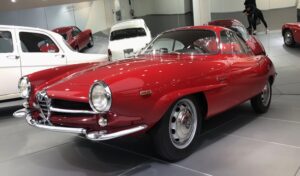
Curvaceous variations on the classic Guilietta theme with with lovely Alfa Romeo Sprint Special at Alfa Romeo Museum in Aresi ItalyTake the stairs down another level and you’re met with the museum’s icing on the cake. This is the motorsport section, holding Alfa’s greatest racing treasures. While studying the cars in any great detail is difficult thanks to the dramatic music, dimming lights and flashy race footage playing on the walls, there is something for every racing enthusiast down here. Exhibits include the 1923 RL Targa Florio, 1940 GP Tipo 512, 1938 8C 2900 B Speciale Le Mans and 1936 GP Tipo C 12C. This is just the first room. The second room is arguably even greater. There is red as far as the eye can see, with iconic Alfas including Guiseppe Farina’s 1950 158 Alfetta, 1967 33 Stradale Prototipo, 1968 Tipo 33/2 Daytona and perhaps the stand out car from the whole museum – the Brabham Alfa from 1977, resplendent in gorgeous Martini livery. Under the lights it looks eye-poppingly good. There could be better looking racing cars, but I’m struggling to think of any.

Martini liveried Bradham Alfa racing car at Alfa Romeo Museum Aresi Italy
This concludes the Museo Storico Alfa Romeo. The drama of the racing section is a fitting way to finish a collection which values quality over quantity. You may be surprised at how few classic cars are actually on display, given Alfa’s extensive back catalogue, but this does nothing to take away from the overall spectacle. Another thing to note is how quiet it is. For someone used to armies of screaming kids running around sticking fingers on displays or wasting endless time waiting for crowds to die down, it was a welcome change to find only two other people roaming the floors at any one time. Staff follow you around, directing you to different displays, eager to help. On the way out I was stopped by an employee who had patiently followed me around the whole museum, waiting for me to finish. He asked politely if I would like to experience the 4D cinema. Naturally I did, and so I was taken into a large room full of bucket seats. Again, I was alone. Like everything else about this place, the cinema was typically Alfa Romeo. You are taken on a POV tour of different race tracks, blasted with cool air, rocked around in your seat and even splashed with jets of water. It was quite the spectacle, if a little much, but cut short by a technical problem. Staff were very apologetic, but I got the idea. Overwhelming, exciting and unreliable. It was the true Alfa experience. There are many good car museums, but few have the charm or elegance of this one. It is, simply, the Alfa Romeo of museums.